
Vergi Hukuku Araştırma Grubu’nun üyesi Dr. Muhammet Durdu’nun “Retroactivity in Binding Case Law: Implications for Turkish Tax Law” isimli makalesi Collected Papers of the Faculty of Law of the University of Rijeka’nin 2025/Vol. 46, No. 3 sayısında
yayımlanmıştır. (Emerging Sources Citation Index – ESCI)
Özet:
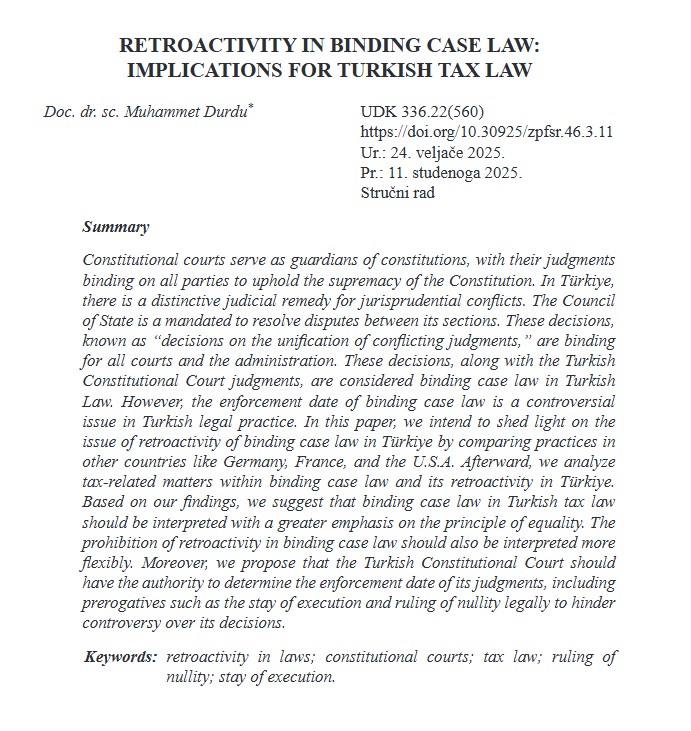
Constitutional courts serve as guardians of constitutions, with their judgments binding on all parties to uphold the supremacy of the Constitution. In Türkiye, there is a distinctive judicial remedy for jurisprudential conflicts. The Council of State is a mandated to resolve disputes between its sections. These decisions, known as “decisions on the unification of conflicting judgments,” are binding for all courts and the administration. These decisions, along with the Turkish Constitutional Court judgments, are considered binding case law in Turkish Law. However, the enforcement date of binding case law is a controversial issue in Turkish legal practice. In this paper, we intend to shed light on the issue of retroactivity of binding case law in Türkiye by comparing practices in other countries like Germany, France, and the U.S.A. Afterward, we analyze tax-related matters within binding case law and its retroactivity in Türkiye. Based on our findings, we suggest that binding case law in Turkish tax law should be interpreted with a greater emphasis on the principle of equality. The prohibition of retroactivity in binding case law should also be interpreted more flexibly. Moreover, we propose that the Turkish Constitutional Court should have the authority to determine the enforcement date of its judgments, including prerogatives such as the stay of execution and ruling of nullity legally to hinder controversy over its decisions.
[Dr. Öğr. Üyesi Muhammet Durdu]
→ https://hrcak.srce.hr/file/492449
 Vergi Hukuku Araştırma Grubu
Yorum bırakın